Bar Fridges
13 products
 Drink & Display Fridges
16 products
 Upright Storage Fridges
8 products
 Underbench & Workbench Fridges
12 products
 Prep Fridges
17 products
 FED-X XR200SG 130L Bar Fridge Glass Door – Commercial Display Bar Fridge
$1,252.90 inc. GST
$1,139.00 ex. GST
View product →
 Upright Storage Freezers
9 products
 Glass Door Display Freezers
4 products
 Chest & Island Freezers
4 products
 Underbench & Workbench Freezers
7 products
 Gelato & Ice Cream Displays
4 products
 FED-X 120L Bar Freezer Glass Door - XF200SG
$1,664.30 inc. GST
$1,513.00 ex. GST
View product →
 Blizzard SN-420P Ice Makers Air-Cooled Cube
$3,732.30 inc. GST
 Blizzard SN-700P Air-Cooled Ice Maker
$4,854.30 inc. GST
 Blizzard SN-1000P Air-Cooled Ice Maker
$5,527.50 inc. GST
 Blizzard SN-120P Underbench Ice Maker Air Cooled
$1,937.10 inc. GST
 Blizzard SN-25C Underbench Bullet Ice Maker 25kg
$1,120.90 inc. GST
 Blizzard SN-80C Professional Ice Maker
$3,358.30 inc. GST
 Blizzard SN-700P Air-Cooled Ice Maker – High Capacity Commercial Ice Machine
$4,854.30 inc. GST
$4,413.00 ex. GST
View product →
 Cafe
45 products
 Restaurant
78 products
 Bakery
26 products
 Pizzeria
38 products
 Takeaway & Fish and Chips
44 products
 Bar & Pub
29 products
 Butcher & Deli
25 products
 Supermarket & Convenience
22 products
Thermaster
65 products
FED-X
27 products
 Bonvue
15 products
 Fagor
9 products
 Blizzard
10 products
 Gasmax
12 products
 Yasaki
9 products
 Benchstar
5 products
Adding pizza to your menu, or upgrading the oven you've got? The right commercial pizza oven depends on how many pizzas you sell, the power you have and who's doing the cooking. This guide explains the three main types (countertop, stone deck and conveyor) so you can pick the one that suits your business.

| Type | Best for | Power | Typical capacity |
|---|---|---|---|
| Countertop | Cafés, bars, kiosks adding pizza | Standard 10A power point | 1–2 pizzas at a time |
| Stone deck | Pizzerias and restaurants wanting a crisp, stone-baked base | Usually 3-phase | 4–8 pizzas at a time |
| Conveyor | Takeaways and pubs wanting consistent results | Usually 3-phase | A steady flow of pizzas per hour |
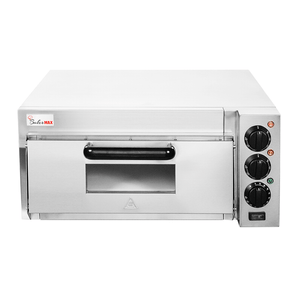
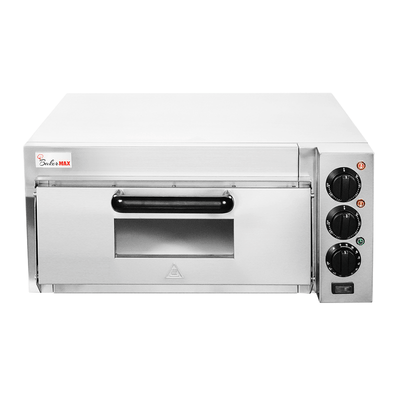
Countertop pizza ovens are compact electric ovens with a pizza stone in each deck. Their biggest advantage is that many plug into a standard 10A power point, so there's no electrician or 3-phase power needed. That makes them ideal for cafés, bars and kiosks testing pizza on the menu.
The BakerMax EP-1T has one deck with a 400 × 400mm ceramic stone and reaches 350°C. The BakerMax EP-2T is the same design with two decks, so you can cook two pizzas at once. Both run on a standard 10A plug.
Keep in mind: countertop ovens run cooler than dedicated deck ovens, so pizzas take longer to cook. They suit low to moderate volumes rather than a busy Friday night rush.
Deck ovens cook pizza directly on a hot stone base, which gives the crisp, blistered crust most pizzerias are after. They run much hotter than countertop ovens and hold more pizzas, and many let you run each deck at its own temperature, so you can bake bread or focaccia alongside pizza.
Keep in mind: deck ovens need someone who knows how to load, watch and turn pizzas, and most need 3-phase power.
A conveyor oven carries each pizza through a heated tunnel on a moving belt. You set the belt speed and temperature once, and every pizza comes out the same, whoever is on shift. That's why conveyor ovens are popular with takeaways, pubs and food courts.
The BakerMax HX-1/3NE is a benchtop conveyor oven that cooks up to 16 pizzas per hour (300mm), with variable belt speed and a fan-cooled exterior that stays safe to touch.
Keep in mind: conveyor ovens need more bench length (the HX-1/3NE is 1510mm wide with its belt extended), and they suit standard pizzas better than artisan styles that need watching.
Work out how many pizzas you sell in your busiest hour, not across the day. A couple of pizzas an hour suits a countertop oven; a busy pizzeria needs a single or double deck.
Check whether your site has 3-phase power before you order. Countertop ovens like the EP-1T and EP-2T plug into a standard 10A outlet, but deck and conveyor ovens usually need 3-phase and must be connected by a licensed electrician.
Experienced pizza makers get the most from a deck oven. If staff change often, a conveyor oven gives more consistent results.
Measure your bench and allow room around the oven for ventilation and safe access. Every product page lists the oven's dimensions and weight, and larger deck ovens can sit on a matching stand.
Yes, some can. Countertop models like the BakerMax EP-1T and EP-2T plug into a standard 10A power point. Most deck and conveyor ovens need 3-phase power.
A double deck oven doubles your capacity in roughly the same floor space, and lets you run two different temperatures. If you expect pizza sales to grow, a double deck gives you room to grow.
It depends on the type. Our countertop ovens reach 350°C, the Prismafood and BakerMax TP deck ovens reach 450°C, and the BakerMax Black Panther reaches 500°C.
For a crisp, stone-baked base, a stone deck oven is the best choice.
Browse our full range of commercial pizza ovens, with delivery Australia-wide. Not sure which suits you? Email us at sales@supplymykitchen.com.au with your menu, power supply and space, and we'll help you choose.